


One common feedback we received for Phoenotopia was to add a map.
Unfortunately, it was too difficult to do since Phoenotopia wasn’t designed with 2D geometric considerations in mind. Perhaps it’s best explained with this picture:
(Note: Chinese Translation of this blog post is available! (Courtesy of Baojie)
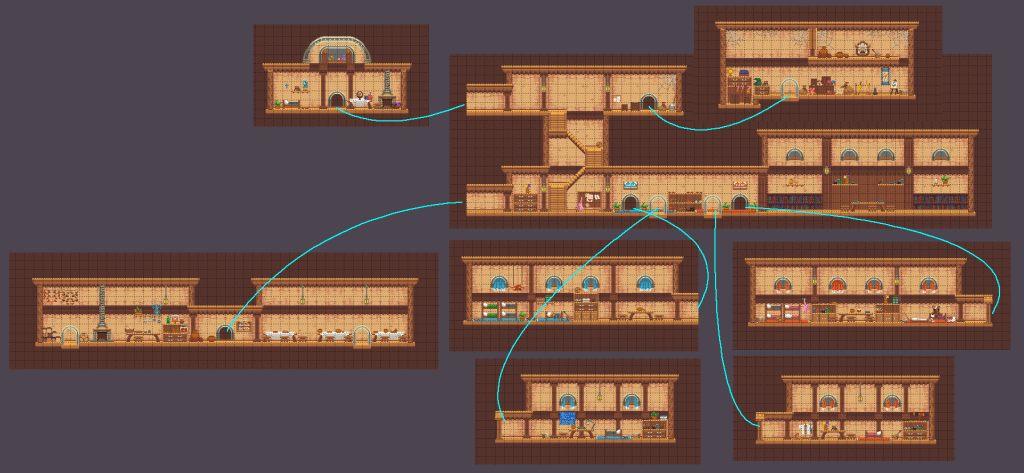
(The starting house. Some say the confusing layout was a metaphor for the difficulties of life in an orphanage home)
Actually, there is a sort of logic to it – if you looked at it from a 3D perspective:
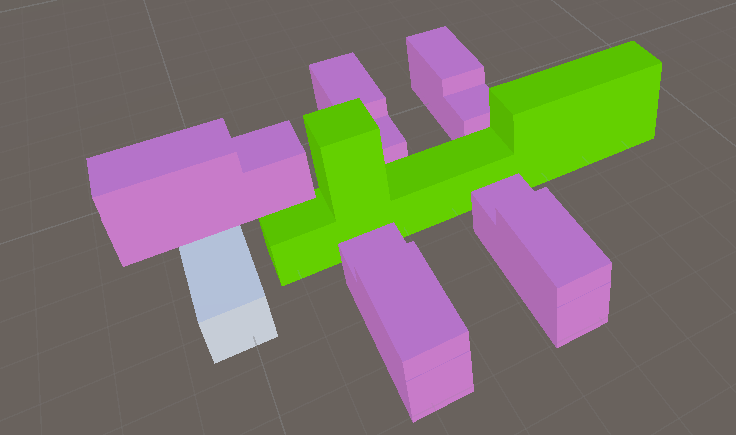
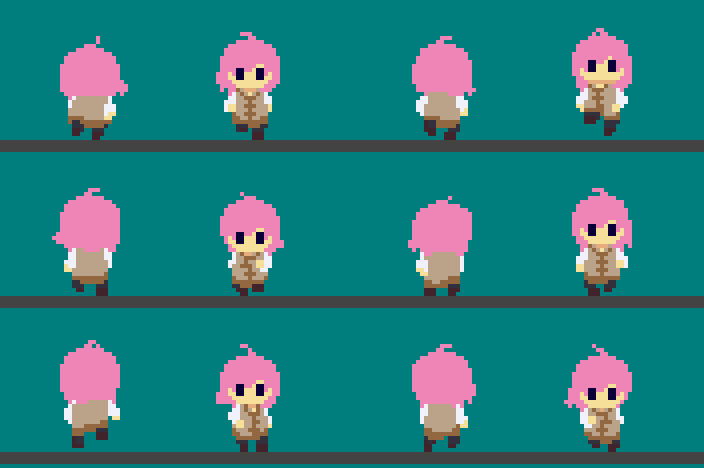
We even animated the main character differently depending on whether she was “running to the front” or “running to the back.” Neat idea in theory, but confusing in practice. Ultimately, it was still a 2D game, and to cram 3D geometry into a flat space just made the world confusing to navigate.
Supporting a map isn’t something you can tack on afterward. It has to be a core design principle from the start. Every level to be designed must be evaluated under the lens of “will this fit into coherent map space?” That’s a very different framework from Phoenotopia, where we treated the canvas as unlimited. That freedom was liberating – but it came at the cost of the game being unchartable.
Communicating the Lay of the Land
For Star Iliad, a map was a priority from day one.
We chose the grid-based format found in classic Metroids and Castlevanias. Since our game is tile-based, this felt like a natural fit: one cell on the map = one room in the game. Easy!
Of course, we studied how the masters did it. In Castlevania: Symphony of the Night, the player is guided horizontally across the castle first. This tour gives players a sense of scale while teasing locked-off areas to revisit later with new abilities.
For us, we similarly wanted to convey to players the “lay of the land”. But I had a different idea for how we could go about this. Set the game inside a giant whale. We know how a whale is shaped, so once the player has explored a little of it, they’d actually get a good sense for the rest.
To demonstrate, here’s a whale fin. Take a good look at it.

Now, close your eyes, and imagine the rest.
Perhaps it looks something like this?
Click to reveal Image
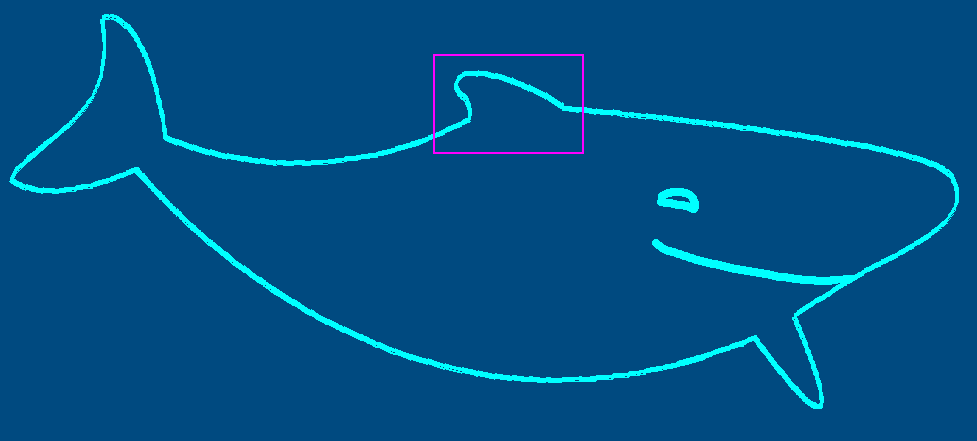
(or see image in separate tab)
When the player knows that it’s a whale and they’ve seen a bit of it, they can infer the rest.
They’ve obtained the “lay of the land”. Externally and internally. Even without being anatomy experts, we generally know what to expect inside: a heart, lungs, stomach, intestines, and so on. The setting itself helps the player mentally chart their progress.
It also sets expectations for scope. If you’ve cleared the lungs, heart, and stomach, you know you still have the liver, intestines, and brain ahead. You understand you’re approximately in the middle of the journey. And as designers, we can play with those expectations. For example, what if the whale had a mystery organ which has no bodily analog to our own?
Getting the Size Right
Perhaps a little unorthodox, but we also wanted to get the size of the whale just right. Map size affects pacing, which as we established earlier, is very important.
Our starting approach was the question – how much space should players cover before reaching the first boss?
We turned to Bloodstained: Ritual of the Night, for an answer. Its intro sequence aboard a ship serves as a tutorial and culminates in a boss fight after about 80 rooms. We actually counted:
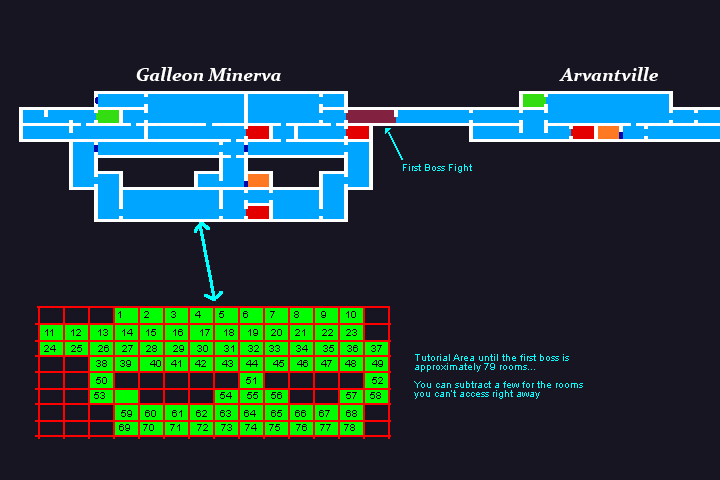
That pacing felt about right. At the time, we planned for the first boss to occur right at the base of the blowhole just before the player enters the Lungs. We scaled this initial gauntlet to be 80 rooms til the first boss. From that, we extrapolated the rest.
Click to reveal (potentially spoilerific) image

(An early whale map draft – back when the whale was still miniature)
(or see image in separate tab)
Of course, room count is only one variable – how large the player character is, how fast they move, how many loops, and how dense the rooms are all radically change the pacing. So “80 rooms til the first boss” wasn’t a hard rule – just a starting plan.
And you know what they say about the best-laid plans.
We would later realize the whale needed to be much larger than the draft above. That meant tearing apart entire levels, expanding them, and stitching them back together – a painful, but necessary process. The reasons why (and what we learned from it) deserve their own post. For now, we’ll end here before this log grows too unwieldy.
Thanks for reading! The next dev update will arrive in two months. See you at the end of November.


 Star Iliad
Leave a comment