DevLog # 02: The Importance of Pacing

Note: Chinese Translation of this blog post is available! (Courtesy of Baojie)

When it comes to making commercial video games, let’s just say it’s not our first rodeo 😎

(It’s our second)

Steam automatically compiles various play data from gamers. From Phoenotopia, I know that we have a roughly even split of keyboard users and gamepad users. From achievements, I can tell which bosses were defeated and how far the player got (although our implementation of achievements requires the user manually unlock it, so it’s less useful data). Today, I want to focus on one specific data point—the median playtime for Phoenotopia.

Unfortunately, the median playtime clocks in at 4 hours.

I think that’s right when the player reaches Atai.
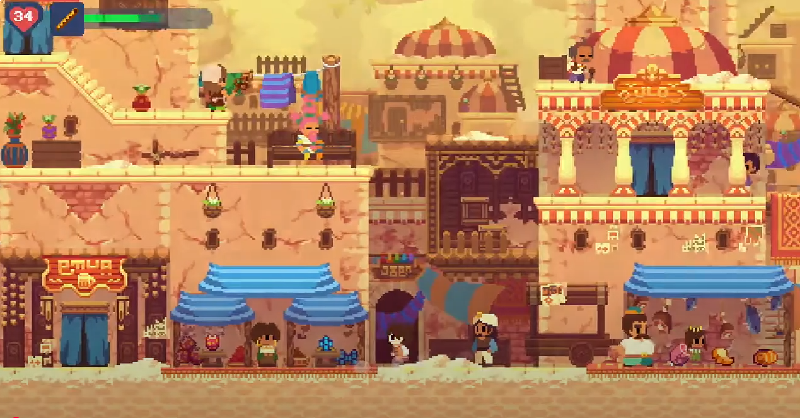
(Atai – the death place of so many playthroughs)

A working theory has been forming:

Atai is the first real “slog” where players are stuck in one place for a long time. It’s a big town with 70+ NPCs to chat with. It’s easy to get lost, feel like you’re not making progress, and then tap out.

Two major quest lines must be completed before reaching the second dungeon: getting the bombs and getting the flute.

Get BOMBS
1. Meet Lisa and learn of her plight
2. Find the bomb maker’s house—it’s locked.
3. Tell Lisa you need to unlock a door.
4. Lisa refers you to Garnet, who gives you a “watch the kids” quest.
5. Play hide-and-seek with the kids.
6. Comb through the entire town looking for the kids
7. Go to the bomb maker’s house and claim bombs

Get FLUTE
1. Meet Lisa and learn of her plight
2. Find the jailed Ouroboros man—he wants wine.
3. Go to the tavern—no ID, no wine.
4. Talk with Lisa and get her ID
5. Dye your hair to look like Lisa
6. Buy wine with fake ID
7. Go to the Ouroboros bandit and exchange it for the flute

Phew. Looking back, that is a LOT. And we don’t even have a quest tracker >_>

I love romping through towns and chatting with NPCs—it’s my favorite part of JRPGs (the genre I’d be making if I weren’t making this). But maybe I let that influence the design a bit too much 🤔

During these quests, there’s very little action—unless players explore optional caves (which don’t quite scratch the itch). So after 1-2 hours of town questing, many players drop off. That’s why so many runs end at 4 hours. That’s my theory anyway.

That brings us to today’s blog topic: PACING

Long story sequences should generally be avoided—it’s a sign of poor pacing. If a long sequence can’t be trimmed down, it should at least be broken up with action. Think of it like making a burger—it needs balance.

(Atai is like the burger on the left—only meaty “story” sequences. A well-paced game is like the burger on the right — it utilizes crucial tomato and lettuce “action” set pieces to mix things up)

Now, one of our new core design goals for Star Iliad is that if you take any 90 minute slice of gameplay from anywhere in the game’s campaign, you’ll experience all of the following:

  • Exploration
  • Combat
  • Puzzles
  • Boss Fight
  • New Upgrade
  • Story Progression

That’s the core “game loop”. Of course, to stay balanced presents its own challenges because we can only control so much. Players set their own pace, and some will inevitably get lost. As designers, we can mitigate this by packing the game with so much content that there’s always something new around the corner – make getting lost fun!

(It’s going to be a lot of work though…)

It does raise some challenging design questions. For example, how can you deliver “story” sequences when you’re deep in the whale’s intestines, far away from town?
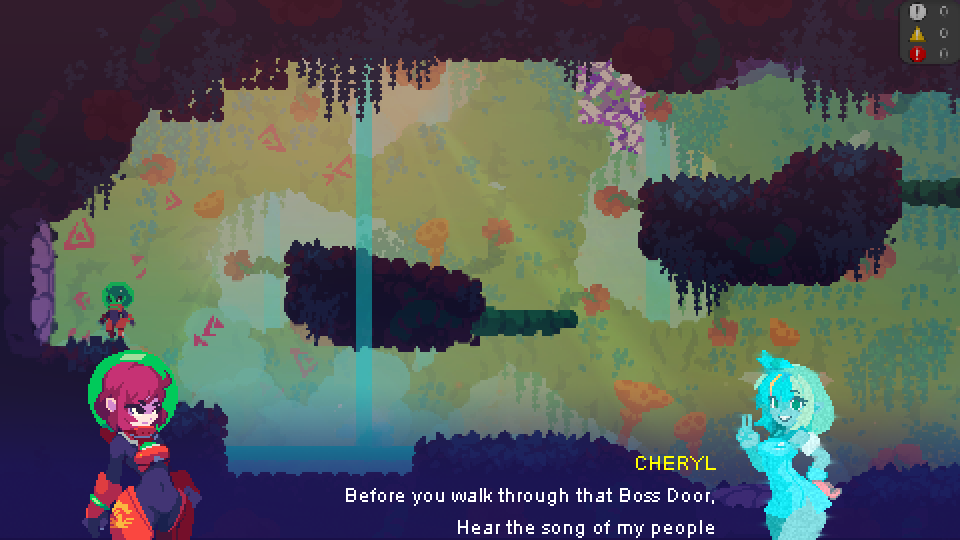
Our answer is to employ something akin to Metal Gear Solid’s codec calls. It’s the future and people have cell phones (or holographic communicators in our case). You can call NPCs and they can call you (Players can also ignore calls if they’d prefer less story)

To conclude —pacing is important! No more hour+ long story sequences! Excepting a couple scenarios – say at a crucial turning point in the game. Long exposition dumps need to be earned. Pacing is something we’re going to be vigilant about through all of development.

(Steve Ballmer understands how important pacing is)

Thanks for reading!

(Next update will be in two months, at May’s end)


Comments

11 responses to “DevLog # 02: The Importance of Pacing”

  1. Personally, I don’t think Atai is badly paced at all. There are a lot of NPCs in Atai, but it’s not like that’s the only thing you do there. In fact, it has pretty much all of the bullet points you mentioned except “boss fight”. There are shops to buy upgrades, secrets to find in the various buildings and plenty of stuff to explore in the sewers, not to mention the various areas surrounding it that you can explore such as the Rhodus Checkpoint. I have played games with lots of talking with NPCs which killed the pacing and grated on me a bit but Phoenotopia is not one of them. Some may argue the sidequest with finding the children is a bit much but I personally loved it, in part, because the NPCs are so charming and full of personality. I don’t think all of a game needs to be this perfectly balanced burger you mentioned. Some times a long section of downtime is actually welcome, presuming it’s well placed, which I believe Atai is after the fairly fast-paced introduction. I don’t think Atai is badly paced or designed at all, though I’m also of the belief that ‘good game design’ is highly subjective and based on personal preferences to a large extent.

    Even putting aside my own personal opinions though, I don’t think the median four hours playtime is very useful for determining whether Atai is badly paced or not. Ultimately, people play at their own pace depending on skill level and preferences. If they’re playing ‘the intended way’ then you can reasonably assume the stopping point to be Atai but you’d be surprised how many people don’t. I got my friend into Phoenotopia and was completely taken aback when they spent over four hours grinding desert lizards and selling their tails for gold before actually progressing in the game. Four hours is also roughly the amount of time you’d need to leave the game on to get all the trading cards. A lot of people (again, including people I know) don’t actually play the game and use a card idler to get all the trading cards for a game without ever going past the main menu.

    Even if we discount those factors, ultimately four hours is kind of the average, or even above average time that people play a game these days. Achievements are a much more useful metric for determining how far people actually played and where they stopped and almost every game I have played has more than 50% of people stopping before they even defeat the first boss or its equivalent. To use an example off the top of my head, Titan Quest, an old ARPG with little story and near non stop action and pacing throughout has a 43.1% unlock rate for defeating the first major boss, on average, less than four hours into the game.

    To use another example, I’m an achievement hunter who uses the site “RetroAchievements”, which adds achievements to retro games. This is a website where you actively need to sign up to even earn achievements on these games and it can be safely assumed that there are more dedicated players who play a game for longer than, say, Steam. Super Mario 64 on this site has an unlock rate of 52.08% for collecting 8 power stars, and only 16% of people actually beat the game. I don’t think many people would argue that Super Mario 64 is badly paced and that’s why 48% of people didn’t even achieve the requirements for unlocking the first boss level.

    This is all to say that I think the ‘median playtime’ data is highly unreliable at best for determining where people even stopped playing Phoenotopia, let alone why they stopped playing.

    Liked by 1 person

  2. Alistun Avatar

    oh, so you like JRPGs? is there any particular game or franchise from which you have taken inspiration for both Phoenotopia and Star Iliad?

    Like

    1. Not a JRPG, but Zelda continues to be an inspiration in both Phoenotopia and Star Iliad (expect to find an upgrade in a dungeon and then use said upgrade to defeat boss). Next, Fire Emblem Three Houses has a couple elements that I’m planning to mine for Star Iliad.

      Liked by 1 person

      1. Three Houses is up there with Phoenotopia Awakening as one of my favourite games of all time so I’m very happy to hear that you’ll be taking inspiration from it. 🙂

        Like

  3. Personally, the Atai sequence is one of my favorite parts of the game. I love all the stuff to see and do, and all the great NPCs to interact with. I get it though, not every gamer stops to smell the roses so to speak, so pacing is indeed key.

    Keep up the good work!

    Like

  4. You are the most interesting game developer I have known, really like to read your blog

    By the way, I think “don’t know what/where is the next step” might be also the reason why gamer quit Atai, on the contrary, the humor and cute NPC conversion are unique and attractive;

    and also, the change in map style is also one of the reasons. Compared with the beautiful green novice village at the beginning, players will suddenly enter a town in the desert, which makes people feel a little insecure.

    The above two feelings, plus the rhythm problem mentioned by the author, are all the reasons I can think of at present.

    Like

  5. Anhilare Avatar
    Anhilare

    Looks like I’m your type of gamer, too, because I’m also one to talk systematically to every NPC (twice) in each town, go to every building, etc. I wonder whether a balance could be achieved by having an (optional) waypoint system? Reminiscent of/related to the “I am here to enjoy the story” difficulty modes that have been appearing in various games of late, in a way.

    On that point, a “I have something new to say” indicator on NPCs could also be useful, something I’ve seen somewhere before but whence I cannot remember.

    Either way, though, I do find myself in agreement with your remedy, and I must say that I would enjoy a roughly consistent gameplay loop, just to help prevent ennui. (But please have a loredump section! Those are my absolute favorites.)

    Like

  6. I decided to quit the game at a platform in the temple, where Kel’s family hadn’t been captured by aliens yet, and the main storyline of the game was still unclear. It was also very difficult for me to jump onto that platform, and I almost gave up on this game. It wasn’t until a few weeks later, when I restarted playing it intermittently, that I gradually became attracted by the vivid characters and storylines in the game.

    Like

    1. The platform blocked me for more than half an hour. By then, I wasn’t very interested in continuing to play, but I still played for a while after getting through. The part of exploring the temples in the game was really boring. The vivid characters, exquisite art design, and unique world view were not presented at that stage.

      Like

  7. Capn_Mosey Avatar
    Capn_Mosey

    I absolutely loved Phoenotopia: Awakening and just completed a second playthrough. One of my friends is currently playing it as well and just hit Atai and I can see where the game can drag for some players at that point. With regards to Star Iliad I just found out about it and am look forward to seeing what comes of it. It sounds like you guys are taking a very healthy approach to it and learning from your first game, putting a lot of thought into what did and didn’t work.
    Artistically, I like the environments as shown so far but Blythe’s outfit looks a bit strange, I think because it doesn’t really look like something that someone would wear, either for style or function. She seems to be wearing a skin-tight jumpsuit with very bulky pieces over her forearms and legs and it just looks kind of odd to me. Regardless, I look forward to hearing more about this game and hopefully seeing it succeed!

    Like

  8. […] wanted to get the size of the whale just right. Map size affects pacing, which as we established earlier, is very […]

    Like

Leave a reply to Bobo Cancel reply