


Spot the difference in this picture of two enemies at the moment of their demise. On the left, an enemy in Phoenotopia. On the right, an enemy in Star Iliad.
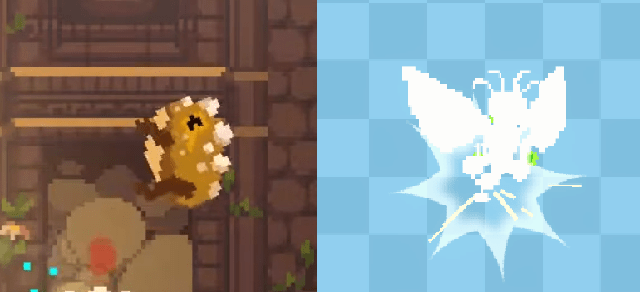
Notice anything? The one on the right sports a “hit glow” FX.
(Note: Chinese Translation of this devlog is available! Courtesy of Baojie)
Phoenotopia surprisingly never had hit glow – something that is pretty much standard for most enemy hit FX in other games. Other tricks Phoenotopia would employ were to shake an enemy on impact (ok, that one is pretty standard), and to shrink an enemy before disappearing it in a puff of smoke.
The common factor behind using those hit effects was that those techniques were free and easy – they didn’t require installing any additional assets or programming any extra shaders. And they looked “good enough.”
During Phoenotopia’s development, technology was kept frozen. Once a solution was found and deemed “good enough“, we left it alone. We were more focused on the sheer size of the content. Keeping a feeler out for new technology felt more like distraction.
And to our credit – we made a game. AND we dodged this Unity BUG that targeted the more modern Unity versions. (Keeping your technology frozen rocks!!)
Still, I did feel a little insecure that our bag of tricks was feeling pretty dated. With Star Iliad, we would once again raise our sails for “New Technology”. For today’s blog post, I’ll chronicle a few of our technological expeditions and their results.
The Expedition for Heat Waves
I wanted a heat distortion effect to convey that a place is HOT. Nintendo had heat waves in Super Metroid’s Norfair 30 years ago on the SNES!
I wanted a similar effect so I’ve researched a variety of solutions. There’s never a straight path with these things – you’ll find there are dozens of tutorials online – some better than others – a discerning eye is needed to find the hidden pros and cons to truly know which one best fits your project.
In the end, we did achieve heat distortions, but with the caveat that you must target the screen entirely or in large swaths. For example, we can target the lower-half of the screen, which looks great when it aligns with a lava pool. However, as soon as you start climbing, the effect breaks.
Looking at the Super Metroid effect again, I see that their heat distortions target the background parallax only 🤔
So, maybe we won’t use heat distortions for the Lava area afterall ¯\_(ツ)_/¯
Luckily, with a bit of tweaking, heat distortions look like watery distortions. And we do plan to have fully submerged aquatic areas that would benefit from watery distortions.
Expedition Result: Half-Success ✅❌
The Expedition for Distortion Waves
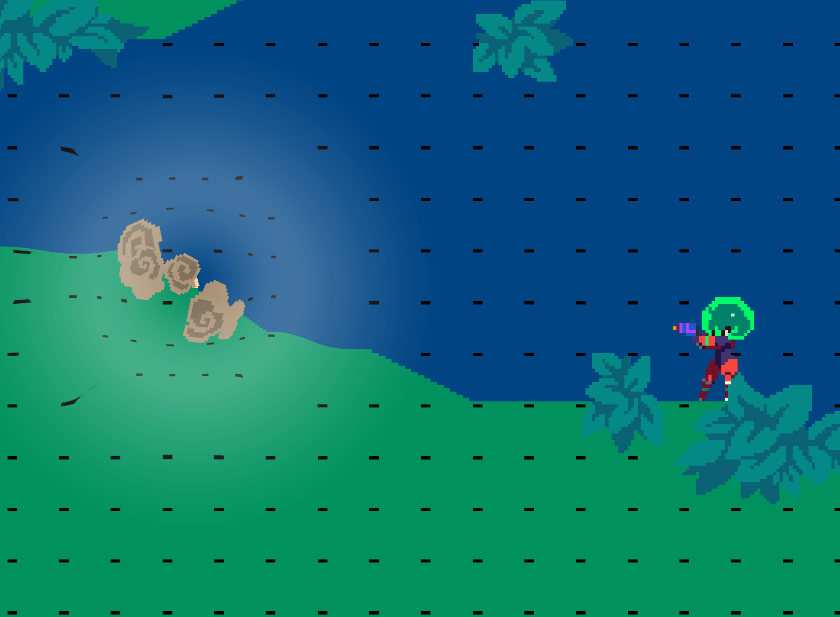
I wanted these Distortion Waves for more satisfying explosions and shockwaves. This has been used in a lot of games, but the trailer for “Momodora: Moonlit Farewell” was the one that galvanized me to finally try for it – a result of the time being right and perhaps because the game sports a somewhat similar art style. Once the game launched, I recorded some gameplay footage for study.
(Yeah, I pretty much do this for every game I play)
Their distortion waves imbue each swing with power!! Notice how only one circular distortion wave at a time seems to be supported? If you ring the bell multiple times quickly, the new wave causes the old wave to disappear.
I believe that kind of behavior is for performance considerations. As it turns out, Star Iliad’s expedition for distortion waves yielded similar results and with the same limitations (albeit we made it support 2 circular waves at a time).
Expedition Result: Success ✅✅
The Expedition for Smarter Enemies
The winding caverns of Star Iliad make it so that enemies that are able to fly or climb should be able to continue their pursuit of the player beyond their patrol zones. To that end, we researched pathfinding for enemies.
Luckily, the literature for pathfinding is pretty settled – use A* search (mostly). There is still work to do in integrating it into the project. For example, you need to think about the granularity of the travel nodes, how enemies can get updated information as new paths open up, or whether enemies are allowed to share knowledge of the map or whether they all have their own model.
(They’re not locked in there with you – you’re locked in there with them!)
Expedition Result: Success ✅✅
The Expedition to reduce Draw Calls
This one began when a teammate reported that the game was running pretty slowly – which kicked off a performance investigation. Normally we’d save optimizations for later, but this slowdown was hitting us now.
My research led me to hone in on the number of draw calls. All the lights and graphical effects on screen were exacting their toll on our teammate’s machine.
A draw call is basically the game telling your graphics card:
“Hey, please draw this thing on the screen.”
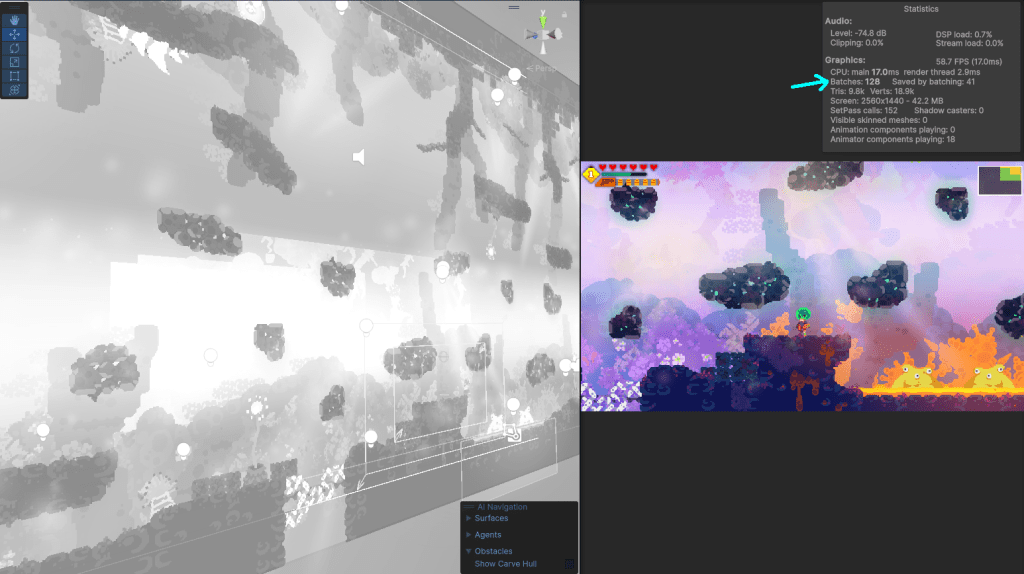
But each request has some CPU overhead. So the more objects you see – enemies, trees, particles, lights – the more little requests the system has to prepare. Too many, and the game slows down. However, if the graphics are set up a certain way, Unity can batch them together into one bigger draw request. Fewer requests means faster performance!
Our expedition however, sent me down a misleading path where I was told that “Material Property Blocks” would solve all our draw-call issues. And long story short… they didn’t.
Later, the teammate needed to buy a new computer anyway for other reasons – and as we were not able to test it further on her old machine, the expedition was suspended.
Expedition Result: Failure ❌❌
As you can see, not all expeditions result in success – some fail and they take a good chunk of your time with it too. But it’s not the case that if an expedition fails, we give up forever more. We’ll reduce the draw calls yet 😤
Closing Remarks
Hopefully you enjoyed that little peek into the different technological expeditions undertaken. There’s a lot more expeditions of varying sizes yet to be touched upon (maybe a part 2 next year?)
Most expeditions are things under the hood : like updating tile maps to modern standards, better menus, sensible cutscene flow, efficient asset management across packages, etc. These quiet unsung workhorses ensure a smoother, more reliable experience for players. They’re not as shiny as an enemy hit glow effect but they’re arguably the most important ones.
Thanks for reading! Amazing to think the year’s almost over. The next update will be in 2 months at the end of January next year.
Til then, have a Merry Christmas and a Happy New Year!!


 Star Iliad
Leave a reply to Steven A Cancel reply